In April 2000, the UK Firework Review
"away team" consisting of myself (Pyro Pete) and
my stunt-double Pete B, were guests of HFM Pyrotechnics
for a huge display at Ellesmere College. In this "digitally
remastered" update for 2004, we feature for the first
time some stunning video clips of the display and of course,
the sixteen inch shell itself in action.
INTRO
To create a finale fitting to the occasion,
HFM obtained one of the largest aerial shells available
for UK use - a whopping sixteen inches
in diameter. Just to prove a point, this would be preceded
by no less than two twelve inch shells!
Of course, we could not turn down the chance
of seeing this kind of pyro in action so despite the four
hour drive, we literally jumped at the opportunity, with
Pete B so excited he was standing at the end of my drive
at 6.15am with a big grin on his face before I had even
shut the front door!
Four hours and a greasy Little Chef fry-up
later, we arrived at HFM HQ "just in time" to help Mike
load the vans with a huge amount of fireworks. This was,
from the number of boxes and large mortar tubes, going to
be quite a spectacle. The highlight of the show, a sixteen
inch Vulcan aerial shell, was so big we could hardly lift
it. Needless to say the mortar tube required to fire this
was wide enough to stand in. As Pete B pointed out, there
was probably more powder in that one shell than in the whole
of our cat 3 displays!
Last minute preparations were made which included
Mike forcing us to wear HFM T-shirts but as it turned out
they weren't half as bad as the red overalls the rest of
his team had to wear (sorry Mike had to get that one in!).
Jumping eagerly back into the car we then tailed the team
to Ellesmere College, a stunning setting for a display.
THE PAYLOADS
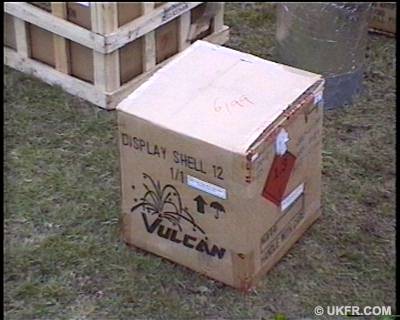
It's difficult to picture what a twelve and
sixteen inch shell looks like, so we'll help you out a bit:
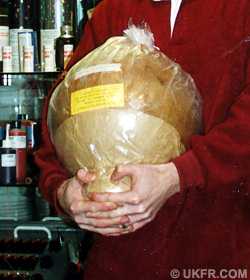
On the left is the twelve inch - remember
this is one single shell - it's bigger
than most complete category three cakes! On the right, the
incredible sixteen inch finale shell, it's not only very
big, it's also very heavy! Again, it's a single shell, the
lifting charge on the bottom needs to be big enough to lift
this thing about 1000ft in the air. The orange string is
part of the shell, this is to help you lower it into the
mortar tube. The comet tail is created by the nodules on
top, which emit sparks as it ascends.
Now take a look at this picture:
The shell on the left is the sixteen inch
one again, so you can take a closer look. On the right for
comparison is a two inch aerial shell, the smallest single
shell most professionals would consider using.
Now it's time for some maths: The two inch
shell is an incredible 69% bigger in diameter than the largest
diameter shell allowed in a category three cake or candle
available to the general public. Now take another look at
the big shell again. If a twenty five shot cake was constructed
using these shells, it would be nearly 8ft x 8ft big including
launch tubes!
SETTING UP
It was like summer when we arrived, and I
have (or rather had!) a tan to prove it, and working with
Mike's team was a pleasure and they really made us feel
at home and part of the team. We would be classed as "trainees"
which of course for safety reasons would mean we would be
put with an experienced member of the team and work under
close supervision, between taking pictures and video.
The firing site was split into two main areas,
on two levels. The higher level was on the playing field
in view of the building and spectator area and most of the
fireworks would be set up here, I would estimate it was
perhaps 100m or more from the audience (a sign of how big
most of the fireworks were going to be). A few hundred metres
behind this, and down a 10m slope was the second firing
area which was used just for the big shells. This was an
ideal venue in this respect because this area was shielded
by a huge bank in addition to being a large distance to
the audience.
The first job of course is unloading the vans,
so we mucked in to get all the pyro and numerous support
items out and ready.
The fireworks were duly set out, rack upon
rack of mortar tubes and huge 1000 shot cakes, although
there were a few familiar faces in there. Blockbuster candles
were a notable cat 3 candle Mike was using for the simple
reason they are very good used in multiples. These were
arranged in fans and other candle bundles were situated
around a big metal arc Mike had built. The idea with this
arc was to fire a huge number of very small bore candles
at the same time, and it worked very well as you will see.
With this number of fireworks in the display
a firing order and plan was needed, and this consisted of
the fireworks being arranged in lines, attached by quick
match fuse (the professionals use this to enable multiple
fireworks to be started at the same time). Thus, the firer
merely needed to light the fuse at the end of each line.
In addition to two huge arrays of aerial shells,
heavy duty noise was going to be created by seven sinister
looking foil-coated (as all the fusing and waterproofing
had been done already) dustbin sized contraptions containing
nothing less than seven titanium salutes in each one. Ouch!
- Click on any
thumbnail to view a bigger picture -
Unloading the van, here Pete B (our own Carol Smilie)
models next to some very big mortar tubes including
the unmistakable 16 inch tube.
General view of the main site looking
towards the distant college (where the spectators
would be situated).
The large metal arc, used to fan out candle bundles
to great effect. You can see a video clip of this
in action later in this feature. The arc was built
in sections to allow easy transport.
A view across the firing site (left
to right) along one line of fireworks. Here we have
four very large cakes, all linked by quick match fuse
which means the firer will light one end and all four
fireworks will start together. Much easier than walking
between them!
Another line of fireworks this time two fans of Blockbusters
with some more waiting to be added. If you follow
the fuse you will see it goes between each individual
candle too, ensuring they all fire together.
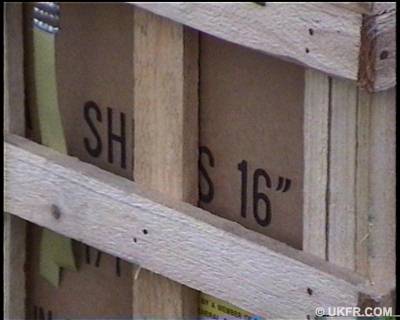
One of the large shell racks (45 six
inchers if I remember correctly) and in the foreground,
the noise makers - seven titanium salute barrages!!!
A rather large rack of shells
And for good measure, here's some more!!
Unfortunately at this point the sun decided
to go in and be replaced by dull, low cloud and a biting
wind. I switched from the stills camera to the camcorder
to record some more setting up, luckily by filming I was
not required to carry any more heavy boxes!
A rack of rockets called "flight rockets"
were prepared - now these are interesting because you don't
see many rockets used professionally. Unlike our cat 3 counterparts,
these have unlabelled plastic heads (making them basic and
therefore cheap) and an instant fuse, allowing a whole rack
to be fused up for rapid fire - a professional would not
want to fire these one at a time. If you ever wondered how
the professionals multiple fire rockets, this is it.
Stills from the video showing the flight rockets
being set up and waterproofed.
Flight
rockets : Getting the flight rockets
ready and covering them with a waterproof
cover. Notice the single length of fuse
that runs along all of the rockets.
3.2Mb Windows Media clip.
Now it was time for the really hard slog,
getting the big bore shell tubes prepared. These would be
fired electrically for safety reasons with the tubes being
mostly buried in the ground. In a professional display,
you have a choice of firing by hand, or by electronic means,
or both. Mike elected to do both, so we and his team could
get our hands dirty with some live firing on the night,
a fact we greatly appreciated. So the big bore items would
be sent up at the press of a button but the rest of the
display would be fired the old fashioned way. As with any
display, the more time you spend setting up, the less you
have to do in the display itself so although it was hard
work it would pay off in the end.
Burying twelve and sixteen inch mortar tubes
is easier said than done - when was the last time YOU dug
a six foot hole? A JCB had been called in to do the hard
part, then an "enthusiastic volunteer" was chosen
to get covered in mud doing the final touches - at which
point I made sure I was busy with the camera, of course.
The following few minutes were unintentionally
hilarious because quite honestly no-one really wanted to
get in a six foot long hole, so the honours fell to Mike's
apprentice who became the "enthusiastic volunteer".
Not sure about the volunteer part of it but I have to say
he remained enthusiastic despite the piss taking. So, we
all stood around the trench watching him dig away.
At this point we realised that the groundsman
who had dug the trench had also taken away all the earth,
and this was needed to fill the hole in again around the
tubes, so Mike had to spend a few minutes chasing this up
to get our mud back.
The hole was finally ready save for a wooden
base to support the possible recoil pressure from the tube.
The apprentice was sent off to find a suitable piece of
timber, the one he found was too big, so his next job was
to break this in half with a spade, heheh...
How many pyrotechnicians does it take to dig
a hole and break a plank of wood in half? Well quite
a few actually although most of these were required
to stand and make suggestions to the apprentice.
The fourth image shows that even with Mike's weight
behind it, the plank just won't break. Finally,
success, and the tubes are buried.
Trainee
runs amok with spade : This is a
long download with no fireworks in it,
but worth it for the entertainment factor
of watching some poor sod slogging away
in a hole while we all take the piss.
4Mb Windows Media clip.
The safety precautions that need to be taken
with this size of firework are incredible. You can't see
it in the picture below, but the tube was several hundred
metres away from the spectator line, and situated in a dip
that acted as a natural barrier - you could not see the
tube from the audience.
Then came the moment we had been waiting for,
the unpacking of the mother of all shells, the 16 inch,
and loading it into the tube. Mike had a great surprise
for us - he'd coloured the shell black and written "BOMB"
on it, very funny, but it did look great and called for
a round of photographs as we took turns to pose next to
this beast of a shell.
The sixteen and then the twelve inch shells
unpacked, followed by a photo session. The shells
are finally loaded and the long wait until the display
begins...
16
inch photo call : Unpacking, fondling
(and in one case almost licking) the
sixteen inch, followed by some macho
poses to show the grandchildren when
we're old farts "Look son, I had
more explosives in my arms than was
used to topple Saddam Hussain".
7Mb Windows Media clip.
THE DISPLAY
After what seemed like ages, we were ready to start
the display's opening. This would be a lone shell fired
every ten minutes in the last half hour run-up to the display,
to let the partygoers know the display was getting ready.
One of these lone shells was a six or eight inch maroon
and the shockwave could be felt against your body, so I'm
sure most of Ellesmere was also watching by the time the
display started.
Mike was kind enough to let me and Pete B fire at least
one item (under supervision). My job was to light some strobes
at the front, after which I had to run a few hundred metres
to my filming point in time to catch the opening (easier
said than done). Pete B was stationed by the 50,000 hanging
crackers, and if you come across him in our forum he has
his own stories to tell about his exploits with those ;-)
So with camera rolling and some very merry guests just
behind me, the strobes signalled the start of an amazing
display. I must at this point apologise for the rather
odd sounding woman in the video clips, I don't know
whether she'd had a G&T too many or was simply overwhelmed
by the fireworks, heheh...
Coloured stars and pretty effects eased the audience into
things nice and gently, followed by a sequence of fanned
blockbusters and then some bigger bore crackling comets.
Now we moved back down to the ground with a number of professional
gerbs. These are like conic fountains, but a lot bigger
and cylindrical in shape. The plume is much higher and they
burn a bit more consistently, but to look at they resemble
huge fountains. Three very pretty purple shells with persistent
comet trails exploded overhead (video clip 1 below).
Now we had some gorgeous coloured stars (mad woman provides
sound track here) which led into one of the "artistic
highlights" for me, the huge metal arc adorned with
candle bundles. This worked extremely well even at the large
distance involved (this would be stunning at 30-50m and
as the candles used were cat 3 there is no reason why it
could not be reproduced in your displays). In this case
a curtain of ruby stars lit up the whole field. Time for
some noise now with a variety of big cakes and some mines,
topped with fans of shells (video clip 2 below).
The pace continued with more cakes, including crackling
and fish effects, leading to a pair of screeching serpent
cakes (the video clip shows how well the quick match fuse
works in these cases). The flight rockets were up next,
although the gold willow (which looked amazing to the eye)
does not show on the video you can hear the unmistakable
whoosh of the launches (video clip 4 below).
Some more cakes continued the action including a pair of
Poisonous Spiders (a rather nice cat 4 cakes that has swirling
silver serpents exploding into coloured stars), these gave
way to some serious shell salvos as the two shell racks
were employed to fill the sky up. Just when you thought
the sound level could not get any higher, the titanium salute
barrages kicked in, blinding flashes and massive bangs rocking
the college (I enjoyed that bit) (video clip 5 below).
And now, ladies and gentlemen, what you have been waiting
for. The finale. Oh yes. Not just any finale. First of all
the sky was torn apart by a barrage of very large shells.
Just as these died down, BOOM! the huge launch thud of something
very big. From behind the tree line two big comets soared
upwards - the 12 inch shells - exploding in perfect unison.
Massive coloured spheres with a pink core. The audience
was delirious thinking that was the end... but then BOOOOOM!
A massive bang, and this was it, the 16 inch.
Like most of the crew, half of the overwhelming feeling
of joy for me at this point was because it had safely launched.
And up it went in an eerie silence. You will have seen the
normal delay between launch and detonation of mid-sized
shells well download the video below and check this out.
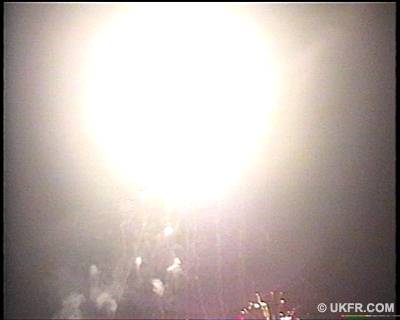
It just went up.. and up... and up... It exploded into a
dense sphere of gold with the bang not reaching us until
many seconds later (it must have reached 1000ft+).
The resulting effect was the best shell I think I have
ever seen. Despite the height and distance it filled the
sky with gold glitter before exploding into further purple
stars. The hang time was similarly impressive, and the audience's
applause at the end said it all. STUNNING.
Still images from the video clips which you
can download below.
Series of still grabs from the video showing
the two 12 inch shells frame by frame.
Series of still grabs from the video showing
16 inch shell frame by frame.
Display
clip 1 : Strobes and coloured stars,
candle fans, gerbs and three shells.
6.3Mb Windows Media clip. Display
clip 2 : Coloured stars, fanned
candle bundles, assorted cakes and shells.
7.1Mb Windows Media clip. Display
clip 3 : Clip of just the excellent
candle bundle fan on the metal arc.
1.85Mb Windows Media clip. Display
clip 4 : Mines, cakes, screeching
serpents and flight rockets. 6.5Mb Windows
Media clip. Display
clip 5 : Cakes, main shell barrages
and titanium salute sequence. 6Mb Windows
Media clip. SIXTEEN
INCH SHELL CLIP! :
2 x 12 inch shells followed by 1
x 16 inch shell. Perhaps the most amazing
cat 4 shells you will see.
3Mb Windows Media clip. 12
inch replay : Slow motion rendering
of the two 12 inch shells (no audio).
1.5Mb Windows Media clip. 16
inch replay : Slow motion rendering
of the 16 inch shell (no audio). 4Mb
Windows Media clip.
ACKNOWLEDGMENTS:
With thanks to Mike and the HFM Pyrotechnics team for their
hospitality and for this unique opportunity to witness some
massive pyro - and share it with UKFR readers.
With thanks to Luvagoodbang (Julian) for his work converting
the analogue source tape to digital, which has made the
new video clips possible.




 A rather large rack of shells